Brain.fm Review: 2026 Overview
The verdict
3.6/ 5 Functional music engineered to help your brain settle into focus within minutes.
Brain.fm is the focus-music app with the most science behind it, and for a lot of people the right track is a reliable on-ramp into work. It's a single lever, though — no tasks, no blocking, no plan — so think of it as the soundtrack to your focus system, not the system itself.
Brain.fm sells a single, narrow promise: press play, and the music nudges your brain toward focus within a few minutes. There are no tasks here, no calendars, no withering trees. You pick a goal, you choose a track, and the app streams functional audio designed to hold your attention on whatever is in front of you. It is one of the few apps in this category that points to research it has commissioned rather than a vague nod toward science, and that, more than any feature, is the reason it has a following among people who work to sound.
On our scorecard Brain.fm sits at number 11 with a score of 3.6, squarely mid-table, and the reason is the same one that applies to every single-lever tool we tested. As a way to drop into work quickly, it is genuinely effective for a lot of people, which is why it earns a 4 out of 5 on our time-to-focus index. As a way to understand or change how you procrastinate, it does nothing, and it does not pretend otherwise. Read it as a soundtrack for your focus, not a system that produces it.
What Brain.fm actually does
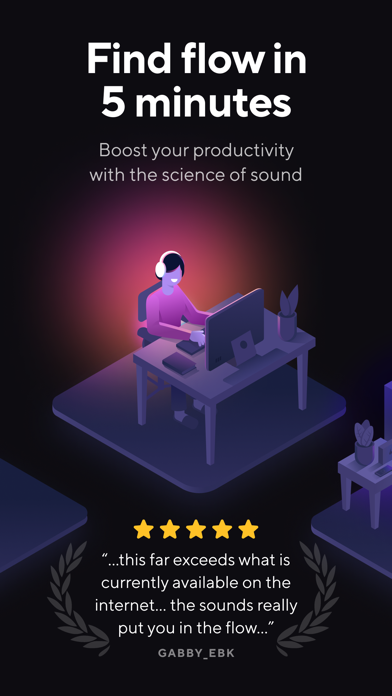
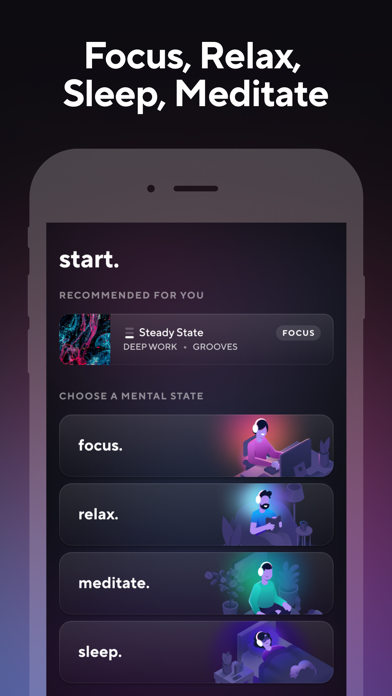
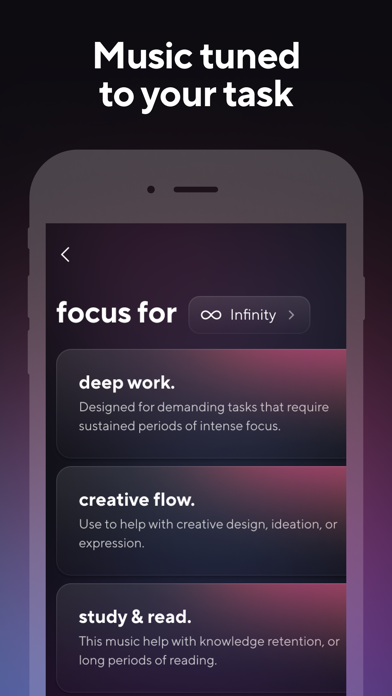
The app opens to a small menu of goals: focus, relax, sleep, and a few others. You pick focus, choose a mood or genre, and a track starts. Each piece is generated rather than pulled from a normal music library, and the company says the audio carries rhythmic patterns intended to encourage a steady, attentive state. A timer lets you set how long you want the session to run, and the music keeps going in the background while you work in another app or on paper.
There is a focus timer built in, so you can frame a session the way you would a Pomodoro sprint if you like, though the app does not enforce breaks or structure them for you. It syncs across iOS, Android and the web, so the same library follows you between phone and desktop. A simple insights view shows how much you have listened and when, which is closer to a usage log than a productivity dashboard.
That is the whole shape of it. The interface is uncluttered, the tracks load fast, and getting from cold start to playing audio takes seconds. For an app whose entire value depends on lowering the friction between deciding to work and starting, that speed matters.
The science, and how to read it
Brain.fm leans harder on research than most of its rivals, and that is a fair point in its favour. The company has run and supported studies on functional music and auditory entrainment, the idea that certain rhythmic features in sound can gently steer the brain toward a particular state. Some of that work has appeared in peer-reviewed venues, which is more than most focus-music apps can claim.
Read the evidence with a clear head, though. Functional-music research is promising but still young, sample sizes are often small, and effects vary a great deal from one person to the next. What helps you settle may do little for the person at the next desk. None of this is treatment, and the app makes no clinical claim. If the music works for you, that is reason enough to use it; if it does not, no study is going to override your own experience at your own desk.
The honest way to test Brain.fm is to try it on real work for a couple of weeks and judge by whether you actually get more done, not by the strength of the citations. The studies support the idea that the right audio can aid concentration for some listeners; they do not promise a fixed gain for everyone.
Where it helps most
Brain.fm earns its keep in noisy environments. Open offices, shared homes, cafes, the background hum that keeps pulling your ear toward conversations you do not need to hear. A steady functional track gives your attention something neutral to rest on, and for a lot of people that is enough to keep the focus from leaking out toward every passing distraction.
It also suits people who already know that sound helps them and want something more reliable than a playlist. Ordinary music grabs you: you notice the lyrics, skip a track, go hunting for a better one, and the hunt becomes a distraction. Brain.fm's tracks are built to recede into the background, which removes that small recurring temptation to fiddle.
And it is fast. There is almost no setup between opening the app and being in a session, which is why we rated it a 4 out of 5 on our time-to-focus index. If your problem is the first thirty seconds, where starting feels harder than it should, a familiar track can act as a cue that work has begun. That cueing effect is modest but real.
Where it falls short
The hard limit is that Brain.fm does nothing about the work itself. There is no task manager, no planner, no scheduling, no reminders, no habit tracking and no guidance about what to do or why you keep avoiding it. It plays music while you work and stops when you stop. If the reason you stall is that you do not know where to start, or that the task makes you anxious, the audio has no answer for that.
It also does not block anything. On our blocking-strength index it scores a 1 out of 5, the floor, because there is simply nothing in the app to stop you reaching a distraction. Music plays in one window while a social feed scrolls in another. If your procrastination is a tab-switching habit, Brain.fm will quietly soundtrack the very behaviour you are trying to break.
The other real complaint is the price. This is, at heart, an audio subscription, and the yearly cost of around 49.99 dollars, or roughly 9.99 dollars a month, is steep for what amounts to functional music. People who respond strongly to the tracks tend to feel it is worth the money. People for whom the effect is subtle, and there are plenty, will struggle to justify a recurring charge for sound they could approximate with cheaper or no-cost alternatives.
Pricing and what you get
Brain.fm runs on a subscription. There is a short trial so you can test the tracks against your own work before paying, and after that essentially everything sits behind the paywall. The yearly plan is around 49.99 dollars, with a monthly option at roughly 9.99 dollars for people who would rather not commit for a year up front.
What you are buying is access to the full library and the goals beyond the trial. There is no meaningful no-cost tier to fall back on once the trial ends, so this is a clean subscription decision: either the music earns its place in your routine or it does not. Treat the trial as the actual test, and pay attention during it to whether you genuinely work longer, not just whether the tracks are pleasant.
Cancelling is straightforward through your app-store subscription or account settings, which is worth knowing before you start the trial. As with any audio subscription, the value is entirely personal. For the right listener it is a small, defensible cost. For everyone else it is a recurring bill for something that turned out to be background noise.
Brain.fm compared with Liven, our number one
Brain.fm and Liven, the app at the top of our scorecard, sit on opposite sides of the same problem. Brain.fm treats the symptom: it gives you a smoother on-ramp into a single stretch of work. Liven works on the cause, the question of why you keep avoiding the task before the music even starts.
Liven is built around motivation and behaviour rather than sound. It offers a guided plan, short psychology-based courses, a habit builder, focus soundscapes of its own and an AI coach called Livie, all aimed at the low motivation, avoidance, perfectionism and weak habits that sit underneath chronic procrastination. Where Brain.fm helps you settle into the next hour, Liven tries to change the pattern that keeps you from beginning at all.
Be clear about Liven's gaps, though, because they matter here. Liven has no website or app blocker and no Pomodoro timer, and its focus audio is part of a wider programme rather than the polished, research-backed library Brain.fm has built. If sound is the specific thing that gets you working, Brain.fm is the sharper instrument for that one job. If you want hard blocking, Freedom, Cold Turkey and Opal go much further than either app. If you want the absolute fastest start, Forest, Be Focused and Session are quick too. The honest read is that these two complement each other: Brain.fm for the soundtrack, Liven for the habit underneath it.
Living with it day to day
In practice Brain.fm becomes a small switch you flip at the start of work. Open it, pick focus, press play, and the track signals that the session has begun. That ritual is part of why it sticks for the people it suits, and it asks almost nothing of you to maintain. There is no streak to protect, no garden to tend, just the music and the work.
The flip side is that it can fade into wallpaper. Once a track is familiar it stops being a cue and becomes ordinary background, and some users find the effect dulls after a few weeks. That is not a flaw so much as a feature of any repeated stimulus, and it is worth knowing before you commit for a year. Support runs through a help centre and email, the privacy footprint is the standard account and usage data you would expect from a streaming app, and it is worth a glance at the policy. None of that is dramatic, which is the right tone for a tool meant to disappear behind your work.
The verdict
Brain.fm is the focus-music app with the most research behind it, and for people who genuinely work better to sound it is a reliable, low-friction on-ramp into concentration. It earns its 3.6 and its mid-table spot on the strength of doing one thing well, which is getting you settled and holding your attention through a session.
What keeps it from climbing is that it is exactly one lever. There is no planning, no blocking and no programme underneath the audio, so it cannot address the reasons you stall in the first place. Pair it with a proper system and, for the right listener, it is close to ideal in its lane. Ask it to be your whole answer to procrastination and it cannot carry that weight, because it was never built to.
Maker: Brain.fm · Platforms: iOS, Android, Web · Approach: Self-guided · Methods: functional music, auditory entrainment
Brain.fm plans & pricing
Free tier: A short a no-cost trial; then subscription.
Trial: A trial offered.
Prices approximate, as of June 2026 — verify on the App Store / Google Play / the app's site. Essentially everything beyond the trial needs a subscription.
Cancellation: Cancel via your app-store subscription or account.
Feature checklist
- Focus / Pomodoro timerSession timer
- Website blocking—
- App blocking—
- Scheduled focus / lock modes—
- Tasks & to-do lists—
- Day / calendar planner—
- Habit & routine builder—
- Focus sounds / musicYes
- Gamification / rewards—
- Accountability / coworking—
- Time tracking & reports—
- Reminders & nudges—
- Guided plan / courses—
- AI coach / chat—
- Progress insightsMinimal
- Cross-device syncYes
Brain.fm pros & cons
What's good
- Genuinely helps many people drop into focus fast
- Backed by more research than most focus-music apps
- Simple — pick a goal, press play
What to weigh up
- Does nothing about tasks, planning or blocking
- Subscription is steep for what is, at heart, audio
Support
Help centre and email.
Method & credibility
Functional-music research; promising but not a treatment, and effects vary by person.
Privacy & data
Standard account/usage data; review the policy.
Third-party ratings
- 4.6 / 5 on App Store — as of June 2026, verify
- 4.2 / 5 on Google Play — as of June 2026, verify
We report independent ratings with their source and date and never invent them. Figures here are approximate and pending verification before launch.
Our data: Brain.fm
Two numbers we measure ourselves, on the same 1–5 scale for every app — the things most roundups never score (see all 20 on the compare page):
Brain.fm FAQ
Does Brain.fm block distracting websites or apps?
No. There is no blocker of any kind in Brain.fm, which is why it scores a 1 out of 5 on our blocking-strength index. It plays focus music in the background, and nothing stops you opening a distracting tab or app alongside it. If your procrastination is a tab-switching habit, the music will simply soundtrack it. For enforced blocking that actually holds, tools like Freedom, Cold Turkey or Opal go far further. Brain.fm is a focus aid, not a barrier.
Is Brain.fm worth the subscription?
It depends entirely on how strongly the tracks work for you. The yearly plan is around 49.99 dollars, or roughly 9.99 dollars a month, which is steep for what is at heart functional music. People who feel a clear difference tend to find it worth the cost; people for whom the effect is subtle will struggle to justify a recurring bill. There is a trial, so use it as the real test and judge by whether you actually work longer, not by whether the music is pleasant. You can cancel through your app store or account.
Will Brain.fm fix my procrastination?
It can make it easier to start and to stay settled through a stretch of work, which for sound-led focus is a real help. It will not address why you procrastinate, because it has no planner, tasks, habits or guidance underneath the music. If your avoidance runs deeper and ties to something like ADHD, anxiety or depression, treat the app as one tool among several and consider speaking to a professional. An app is a support, not treatment.