
Habitica Review: 2026 Overview
The verdict
3.7/ 5 Turns your tasks and habits into a role-playing game, complete with a party that holds you to it.
Habitica is the most fun way to build habits if rewards and a bit of peer pressure light you up: your to-dos become an RPG, and your party notices when you slack. It can tip into busywork, and there's no blocker or timer — but as a near-no-cost motivation engine it's one of a kind.
Habitica asks an unusual question of a productivity app: what if your to-do list could kill your character. You build a little pixel-art avatar, and your real-world tasks become the game. Tick off a chore and you earn experience, gold and the odd piece of gear. Skip a daily you committed to and your health bar drops, sometimes far enough that the avatar dies and you lose progress. It has been going since 2013, it grew out of an open-source project, and it remains the most literal attempt anyone has made to turn habit-building into a role-playing game.
On our scorecard Habitica lands at number 8 with a score of 3.7, which puts it in the upper-middle of the table for a fairly specific reason. As a motivation engine it is genuinely clever, especially the social side, where a party of other players takes damage when you slack. As a tool for getting from idle to working, or for walling off a distraction, it does almost nothing, and it does not pretend to. We rate it 1 out of 5 on blocking strength and 2 out of 5 on time-to-focus. Read it as a reward system for the habits you already know you should keep, not as a way to stop reaching for the distraction in the first place.
What Habitica actually is
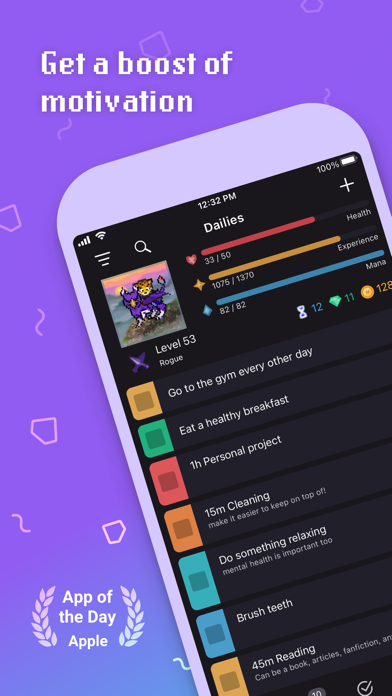
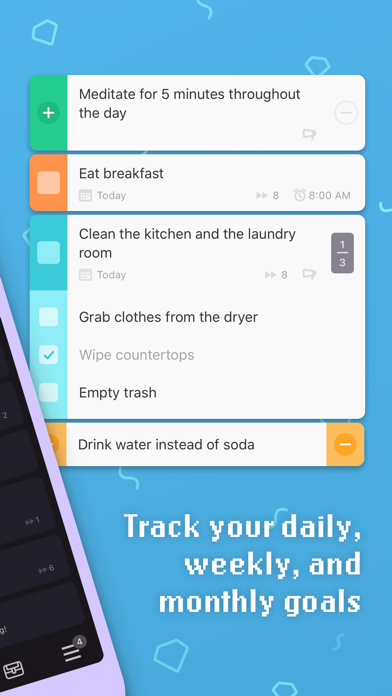
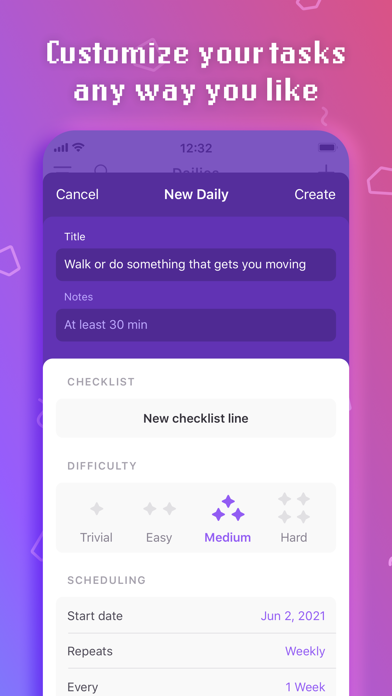
Strip away the costume and Habitica is a habit tracker and task manager with a game bolted firmly on top. You work in three columns. Habits are behaviours you want more or less of, scored with plus and minus buttons each time they happen. Dailies are the things you commit to on a set schedule, and these are the ones with teeth, because missing them hurts your character. To-dos are one-off tasks that simply get checked off when done. Every positive action feeds experience and gold; every missed daily chips away at your health.
Around that loop sits the role-playing layer. You level up, unlock classes, buy gear and pets, and spend gold on rewards you define yourself, which can be in-game items or real treats you have decided to earn. It runs on iOS, Android and the web, and syncs across them, so the same character and task list follow you between phone and desk. The methods on offer are gamification, habit loops and accountability, and Habitica leans on all three harder than almost anything else in this category.
It is worth being clear about what is not here, because the gaps matter for an anti-procrastination tool. There is no focus timer and no Pomodoro feature, no website or app blocking, no scheduling or planner beyond the daily list, no focus soundscapes, no time tracking and no coaching or guidance. Habitica rewards the behaviours you log. It does not help you choose them, time them, or keep you off the things pulling your attention away.
How the gamification helps you start
For the right person, the game is a real lever. Procrastination is often a problem of payoff timing. The reward for doing the boring task is distant and abstract, while the reward for avoiding it is immediate. Habitica inverts that for a moment. Tick the task and something good happens right now: a number goes up, gold drops, a level bar inches forward. That small, instant hit of progress can be enough to make a dull task feel worth starting, which is the hardest part of any task to manufacture.
The reward economy is the engine. Because you set your own rewards and spend the gold you earn, you can wire genuine motivation into the loop, letting yourself buy an in-game pet or a real coffee only once you have banked the work to pay for it. People who respond to points, streaks and unlockables tend to find this far stickier than a plain checklist, and that is the whole pitch. If a number going up makes you want to do the thing, Habitica turns your week into a steady supply of numbers going up.
There is honest nuance here, though. The reward nudges you to record a habit you were already willing to do. It is much weaker on the tasks you actively dread, because no amount of pixel gold makes you open the document you have been avoiding for a week. As a motivator for maintenance habits it works well. As a way to break through serious avoidance, it leans on willpower you may not have on the day.
The party, and why accountability is the strongest feature
Habitica's best idea is social. You can join a party with friends or strangers and take on boss battles together, where the damage you deal comes from completing your own real tasks. The sharp twist is that missing your dailies does not only hurt you. It damages your whole party, because uncompleted dailies can trigger attacks on the group. Suddenly your private slip has witnesses, and a few people who would rather you did your washing-up so the boss goes down faster.
That mild peer pressure is a more durable motivator than solo points for a lot of people. Letting yourself down is easy to shrug off; letting down four others mid-battle is harder. It is the same mechanism that makes gym buddies and study groups work, ported into a game. For anyone who has found that accountability is the thing that actually keeps them honest, the party feature alone can justify the app.
It is not friction-free. Parties depend on the other members staying active, and a group that drifts off takes the accountability with it. There is some etiquette to learn, and the social layer adds setup before the magic kicks in. But when a party clicks, this is the part of Habitica that does something genuinely few rivals do, and it is the main reason the app scores as well as it does on our table.
Where it falls short
The biggest catch is the one the cons make plain: the game can become the procrastination. Tweaking your avatar, shopping for gear, fiddling with the colour of your habits and reading up on classes are all things you can do instead of the actual work, and they feel productive while you do them. An app meant to fight avoidance can quietly hand you a new and quite absorbing thing to avoid with. Not everyone falls into this, but it is a real failure mode worth naming.
Then there is what is missing. Habitica has no focus timer and no Pomodoro, so it cannot help you protect a block of work once you start. It has no website or app blocking at all, which is why it sits at 1 out of 5 on our blocking-strength index, the floor of the scale. If your distraction is a tab or an app, Habitica will happily let you wander off and will simply note that the daily went unticked. It records the miss; it does nothing to prevent it.
The interface is also showing its age. The retro pixel aesthetic is charming to some and cluttered to others, and the initial setup, defining habits, dailies, schedules and rewards, takes real effort before the loop starts paying off. That upfront cost is a barrier for exactly the people who struggle to start things, which is a slightly awkward irony for an anti-procrastination tool. Stick with it and the system runs itself; bounce off the setup and you never see the benefit.
Pricing and what you get
The headline is that the core game costs nothing. You can build habits, run dailies and to-dos, join a party, fight bosses and level up your character without paying, and for most people that is the whole experience. This is unusual in the category, where the genuinely useful features are often the ones behind a paywall. Here the engine that matters is open to everyone.
The optional subscription runs at roughly 4.99 dollars a month or around 47.99 dollars a year. What it buys is largely cosmetic and supportive rather than functional: gems, exclusive pets and gear, drop bonuses and the warm feeling of funding a project with open-source roots. It is closer to a tip jar with perks than a paywall on the core loop, and you can run Habitica indefinitely without it. Prices are approximate as of mid-2026, so check the current figures before subscribing.
If you do subscribe and change your mind, you cancel through your app-store subscription and the core game carries on as before, character and history intact. That is a fair arrangement. You are paying to support the app and decorate your avatar, not to keep the lights on, and nothing you built disappears when you stop.
Habitica compared with Liven, our number one
Habitica and Liven, the app at the top of our scorecard, both care about habits, but they aim at different layers of the problem. Habitica rewards the behaviour: you decide what you want to do, and the game pays you in points and peer pressure for doing it. Liven works one level down, on why you keep avoiding the behaviour at all, which is the part a reward system cannot reach. If you keep setting up the perfect dailies and then not ticking them, the issue is usually not the lack of a points system.
Liven folds a guided plan, short psychology-based courses, a habit builder, mood check-ins, focus soundscapes and an AI coach called Livie into one program, aimed at the avoidance, perfectionism, low motivation and weak habits that sit beneath chronic stalling. It is self-guided support rather than therapy. And to be plain about its own gaps, Liven has no website or app blocker and no Pomodoro timer either, so on hard blocking it loses to Freedom, Cold Turkey and Opal, and on getting you focused fast it loses to Forest, Be Focused and Session. Liven leads neither of our two indices, and neither does Habitica.
The two are more complementary than competing. Habitica is the better pick if external rewards and a bit of group accountability are what reliably get you moving, and Liven has no game layer to match that. Liven is the better pick if you understand your habits perfectly well and still cannot make yourself act on them, because it addresses the motivation underneath rather than dressing it up as a quest. If you want a pure system instead, TickTick and Todoist organise the work better than either; if your stalling ties to ADHD, Tiimo and Focusmate are built more squarely for that.
Who it suits
Habitica is at its best for people who are genuinely motivated by games and rewards, the sort who have happily ground levels in an RPG and feel a small pull from a streak or an unlockable. If that is you, the app converts ordinary admin into something you almost want to do, and that conversion is rare and valuable. It also suits anyone who builds momentum through group accountability, since the party feature is the strongest thing on offer.
It works well for people building several habits at once, because the three-column layout of habits, dailies and to-dos handles a fuller routine than a single-purpose tracker. If you want one place to nudge a dozen small behaviours and you respond to the scoring, the breadth is the point. It rewards consistency and a willingness to do the setup, and it pays that effort back over months.
It is a weaker fit if your distraction lives on the device itself and you need something to block it, since there is no blocking here at all. It is a poor fit if you need to be pushed into a single block of focused work, because there is no timer. And if your procrastination is rooted in deeper avoidance, anxiety or low mood rather than a missing reward, a game cannot reach that, and a tool that works on motivation will serve you better.
Privacy, support and the verdict
Habitica has open-source roots, which tends to come with a more transparent posture than most, and on our reading the privacy handling is reasonable. As with any app that holds a running record of your daily routines, it is still worth reading the current policy yourself, particularly if your dailies reveal sensitive detail about your life. Support comes through a well-stocked wiki, an active community and email, which suits a tool that leans this heavily on its players.
One honest caveat about scope. Habitica is a motivation and habit tool, not a clinical one. Everyday procrastination is normal, and a reward loop helps with it. But if your avoidance is persistent and tied to something heavier such as ADHD, anxiety or depression, a points system will not be the answer, and it is worth speaking to a professional. The app is a support, not treatment, and it does not diagnose, treat or cure anything.
The verdict is that Habitica earns its 3.7 and its place in the upper-middle of the table on the strength of one thing done with real personality: turning habits into a game that other people are playing alongside you. The interface is dated, the setup is fiddly, and there is no timer or blocker to lean on, so it cannot carry the whole job of beating procrastination by itself. But as a near-no-cost motivation engine for people who respond to rewards and accountability, it is genuinely one of a kind, and nothing else on our list scratches that particular itch.
Maker: HabitRPG, Inc. · Platforms: iOS, Android, Web · Approach: Self-guided, gamified + social · Methods: gamification, habit loops, accountability
Habitica plans & pricing
Free tier: Largely usable without paying — the core game is no-cost.
Trial: n/a (no-cost core).
Prices approximate, as of June 2026 — verify on the App Store / Google Play / the app's site. Subscription adds cosmetics, gems and perks; it's support, not a paywall on the core.
Cancellation: Cancel via your app-store subscription; the no-cost game continues.
Feature checklist
- Focus / Pomodoro timer—
- Website blocking—
- App blocking—
- Scheduled focus / lock modes—
- Tasks & to-do listsYes
- Day / calendar planner—
- Habit & routine builderYes
- Focus sounds / music—
- Gamification / rewardsYes
- Accountability / coworkingParties & guilds
- Time tracking & reports—
- Reminders & nudgesYes
- Guided plan / courses—
- AI coach / chat—
- Progress insightsBasic
- Cross-device syncYes
Habitica pros & cons
What's good
- Genuinely fun gamification — XP, gold, gear and a party that punishes you for skipping
- Largely free
- Combines tasks, dailies and habits in one place
What to weigh up
- The game can become the procrastination
- Dated interface; no timer or blocking; setup takes effort
Support
Wiki, community and email.
Method & credibility
Gamification and social accountability; a motivation tool, not treatment.
Privacy & data
Open-source roots; review the policy. Reasonable on our reading.
Third-party ratings
- 4.3 / 5 on App Store — as of June 2026, verify
- 4.2 / 5 on Google Play — as of June 2026, verify
We report independent ratings with their source and date and never invent them. Figures here are approximate and pending verification before launch.
Our data: Habitica
Two numbers we measure ourselves, on the same 1–5 scale for every app — the things most roundups never score (see all 20 on the compare page):
Habitica FAQ
Does Habitica block distracting websites or apps?
No. Habitica has no website or app blocking of any kind, which is why it scores 1 out of 5 on our blocking-strength index, the bottom of the scale. It will reward you for the work you log and damage your character if you skip a daily, but it does nothing to keep you off a distracting site or app in the moment. If hard blocking is what you need, look at Freedom, Cold Turkey or Opal, and consider pairing one of them with Habitica for the motivation side.
Is Habitica really usable without paying?
Yes. The core game is open to everyone at no cost: habits, dailies, to-dos, joining a party, boss battles and levelling up are all included. The optional subscription, at roughly 4.99 dollars a month or about 47.99 dollars a year, mostly adds cosmetics, gems and perks rather than unlocking the parts that matter. Most people can run Habitica indefinitely without ever paying, and the subscription is closer to supporting the project than removing a paywall.
Will Habitica actually stop me procrastinating?
It can make the habits you already want to keep more rewarding to do, and the party feature adds real accountability, which for some people is the deciding factor. What it will not do is help you start the tasks you genuinely dread, protect a block of focused work, or block a distraction, since it has no timer and no blocker. There is also a risk the game itself becomes a way to procrastinate. If your avoidance runs deeper and ties to something like ADHD or anxiety, treat the app as one tool among several and consider speaking to a professional.